








When the 2018 MLCC shortage hit, parts that once cost pennies suddenly threatened million-dollar production losses. In this case study, see how Sensible Micro helped a global electronics manufacturer secure critical Kemet capacitors, approve alternates faster, and keep production running without a line-down event — and why today’s buyers should be paying close attention to similar market signals.
01 THE MARKET CONTEXT
2018: When One-Cent Components Became Million-Dollar Problems
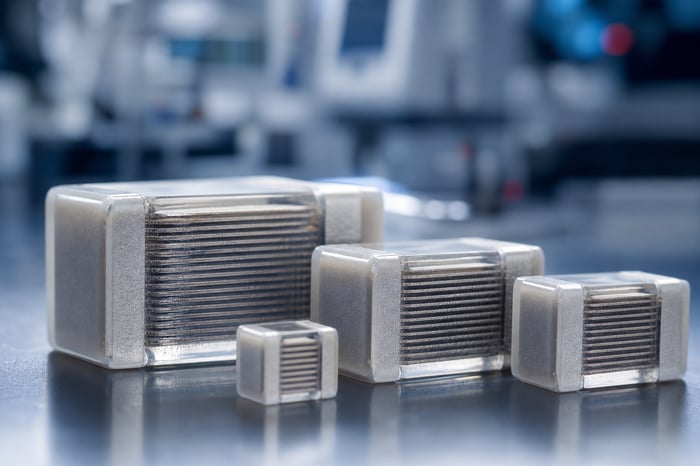
Multilayer ceramic capacitors — MLCCs — are among the most common passive components in electronics manufacturing. They are small, inexpensive, and for most of the industry's history, reliably available. Buyers rarely thought about them twice.
That changed in 2018. The automotive sector, rapidly scaling production of electric and connected vehicles, consumed MLCC inventory at a rate the market had never seen. Component manufacturers prioritized their largest accounts, the automotive OEMs, and inventory that had been freely available across other industries disappeared almost overnight.
"It happened so quickly. These were parts that until then really had not experienced issues like this, they weren’t even on buyers' radars. When they went to buy them from normal suppliers, they were just gone." — Joe M., Sensible Micro
The situation was made worse by lead time. Engineers scrambled to qualify alternative manufacturers and alternate part numbers, but the process of getting engineering approval took weeks. By the time a new part was approved and ready to order, that inventory was gone too — often at prices three to four times higher than buyers had paid the month before.
MARKET DATA
Parts that had traded at $0.01–$0.05 each were selling for $0.10–$0.20 each within days. On standard 10,000-unit reels, that pricing movement translated to thousands of dollars of additional cost per line item, and manufacturers needed hundreds of line items to keep production running.
02 THE CHALLENGE
A Major Consumer Electronics Manufacturer Faces a Line-Down Crisis
When the shortage hit, a major global consumer electronics manufacturer, a household name in audio products, found themselves in an increasingly urgent situation. The Kemet MLCC capacitors their production lines depended on were no longer available through their normal supply channels.
In manufacturing, a line-down event is among the most costly outcomes a supply chain team can face. Production stops. Factory workers still need to be paid, furloughed, or let go. Contractual delivery commitments to downstream customers become impossible to meet, triggering fees and penalties. Every day without parts is a day the business bleeds.
The procurement team needed parts fast. And they needed a partner who could move at the speed the situation demanded.
03 HOW IT STARTED
The Right Call at the Right Moment
The relationship began with a cold call. A Sensible Micro sales representative reached out to the manufacturer's procurement team right at the moment they were actively searching for a solution. The conversation was immediate: the buyer's first question was whether Sensible Micro could find Kemet capacitors.
They could. Within weeks, the manufacturer had placed over one million dollars in POs with Sensible Micro, sourcing the Kemet MLCCs their production lines needed at a time when virtually no one else in the market could find them.
04 WHAT SENSIBLE MICRO DID DIFFERENTLY
Speed, Flexibility, and Outside-the-Box Sourcing
Keeping the manufacturer's production lines running required Sensible Micro to work in ways that most distributors in 2018 simply weren't built to do.
Around-the-clock sourcing
When allocation windows opened at component manufacturers and partner distributors, inventory moved in minutes. Sensible Micro's sales team, including senior leadership, sourced parts in the early morning hours and late at night, before other buyers could access the same pools of available inventory. Parts were received overnight and shipped overnight, with lead times of two to three days and, in critical situations, same-day courier delivery.
Engineering-grade alternate sourcing
When exact part numbers weren't available, Sensible Micro's team worked with the manufacturer's engineers to identify functionally equivalent alternatives. The key was understanding component tolerances: a capacitor rated at a specific value with a 20% tolerance has an acceptable range. A tighter-tolerance part — say, 10% — falls within that range and is technically a superior specification.
In practice, this meant that when the manufacturer's exact part number was unavailable, Sensible Micro could offer a compatible alternative that engineering could approve on the spot, often the same day, rather than waiting weeks for a formal qualification process.
TECHNICAL EXAMPLE
Customer requests C0805C105M3RAC (20% tolerance) — unavailable in the market. Sensible Micro identifies C0805C105K3RAC (10% tolerance) as an available alternative. The tighter-tolerance part meets all functional requirements. Engineering approves same day. Production continues.
Inventory reservation during approval delays
One of the structural problems buyers faced in 2018 was organizational: procurement teams often knew they needed parts, but securing internal sign-off on large purchase orders took time. In a market where pricing could triple and inventory could disappear between Monday morning and Monday afternoon, that approval lag was existential.
Sensible Micro's solution was to allow buyers to sign a reservation agreement — a commitment document that allowed Sensible Micro to secure and hold inventory while the buyer awaited internal approvals. The parts were taken off the market. The buyer's production line was protected. The PO could follow when it was ready.
05 THE RESULTS
Production Kept Running. Not Once Did the Line Go Down.
Over the course of the shortage, the manufacturer sourced more than one million dollars in MLCC components through Sensible Micro across a two-month period. Their production lines never experienced a line-down event attributable to component availability.
In a market where factories were shutting down production, furloughing workers, and paying delivery penalties to downstream customers, the manufacturer maintained continuity. Protected by a supply chain partner who moved faster, thought more flexibly, and held inventory when the approval process couldn't.
06 WHY THIS MATTERS TODAY
Experienced Buyers Have Seen This Pattern Before
While the market conditions aren't identical to 2018, the MLCC market of 2026 is showing signals that experienced supply chain professionals recognize. AI infrastructure buildout, driven by demand for custom accelerator platforms from hyperscalers including Google, AWS, and Meta, is consuming high-capacitance, low-voltage, and miniature MLCCs at an accelerating rate.
Book-to-bill ratios at the world's three largest MLCC manufacturers — Murata, Samsung Electro-Mechanics, and Taiyo Yuden — have reached their highest levels since the onset of COVID-19. Murata's orders-to-backlog ratio has already surpassed the peak recorded at the start of the 2018 shortage.
Lead times at authorized distributors are already extending beyond 25 weeks on certain series and those distributors have begun restricting sales to end users only, cutting off the open-market channels that buyers often rely on during allocation crunches.
"The best time to secure inventory is before everyone realizes they need it. These parts only cost pennies, but they can cost millions if the market hits another disruption like it did in 2018. " — Joe M., Sensible Micro
The buyers who fared best in 2018 weren't the ones who responded fastest when the shortage hit. They were the ones who had already established relationships with partners who could move when the market couldn't. The buyers who struggled were the ones who, when inventory disappeared from normal channels, had no one to call.
07 WHAT BUYERS SHOULD DO NOW
Three Steps Before the Allocation Closes
Establish a stocking program for high-risk passives now.
MLCCs are low unit-cost components. Holding safety stock against a potential shortage is a fraction of the cost of a single line-down event. Sensible Micro offers stocking programs that allow buyers to secure inventory at current pricing before market conditions shift.
Identify your critical MLCC series before they're unavailable.
The Murata GRM/GCM series, TDK CGA series, and Kemet C0603/C0805/C1210 series were at the center of the 2018 shortage. Buyers who know their BOM dependencies on these series can act proactively. Buyers who don't know won't find out until the allocation is already gone.
Build the relationship before you need the rescue.
The manufacturer in this case study didn't have a pre-existing relationship with Sensible Micro, they got lucky with timing. Most companies in their situation didn't. A managed stocking program or vendor consolidation arrangement established now means that when the market moves, the response is already in place.