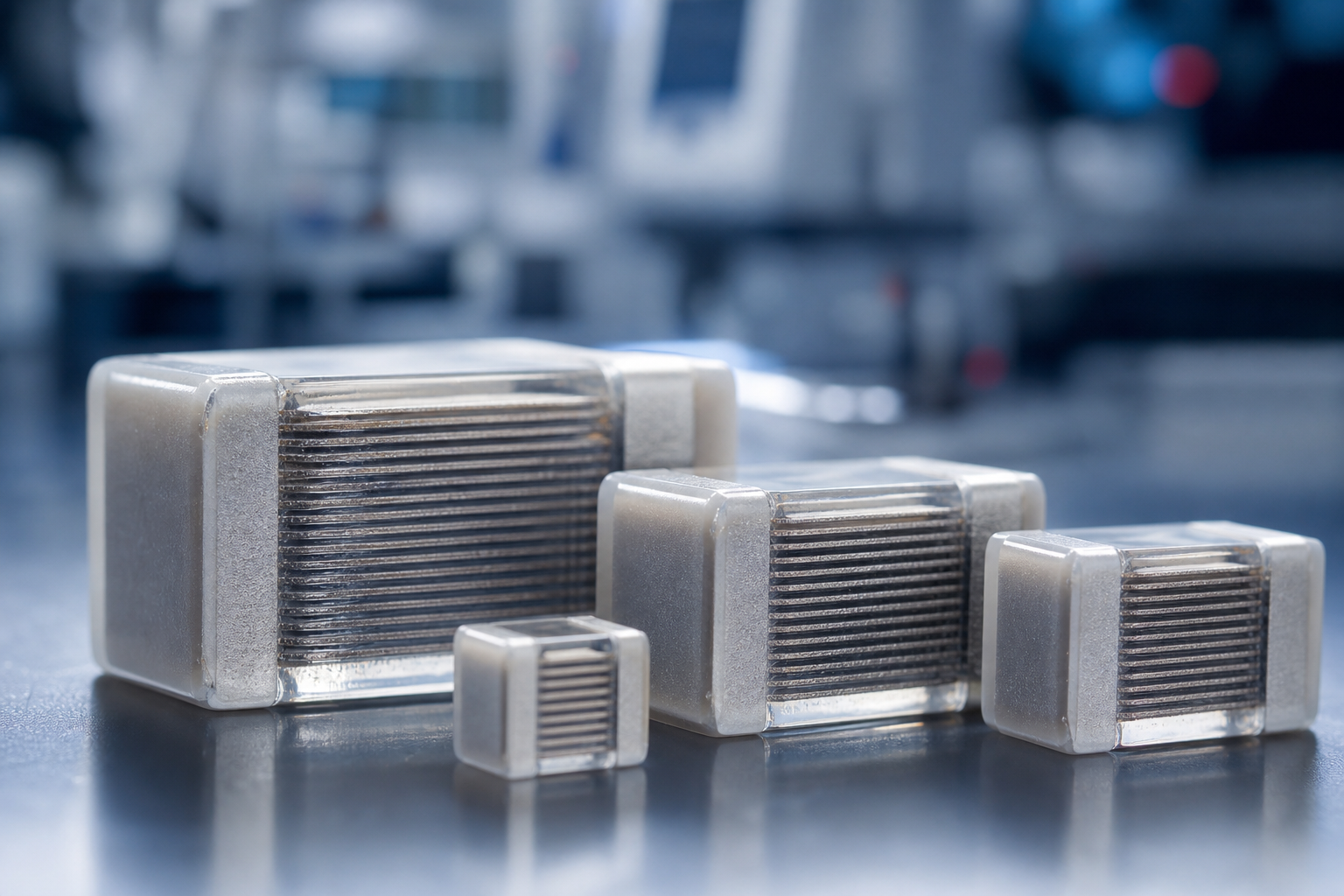











If you’ve been in electronics procurement long enough, the current MLCC market has a feeling you might recognize.
Lead times at authorized distributors stretching past 26 weeks on constrained families. Open-market purchase activity on Samsung and Murata high-capacitance parts surging 300 to 560 percent month-over-month. Murata confirming that new high-end capacity won’t come online before Q4 2026. Price increases already implemented by Murata, Samsung Electro-Mechanics, Taiyo Yuden, Yageo, and Walsin, with forecasts calling for another 20 to 30 percent on general high-capacitance grades, and 30 to 50 percent on ultra-high-cap parts through the second half of the year.
We’ve seen this movie before. The last time it played, it ran for 18 months and cost buyers who waited far more than the ones who moved early.
What Happened in 2018, and Why It Caught the Industry Off Guard
The 2018 MLCC shortage didn’t arrive without warning. It built through 2017 as automotive demand, driven by the rapid scaling of electric and connected vehicle production, began consuming passive component inventory at a rate the market hadn’t accounted for. Component manufacturers, as they always do, prioritized their largest accounts. Automotive OEMs moved to the front of the allocation line. Everyone else fell behind.
The parts that disappeared weren’t exotic. They were the commodity workhorse components that procurement teams had never thought twice about. X5R and X7R dielectrics in 0402, 0603, and 0805 case sizes in common values like 0.1µF, 1µF, and 10µF. The Murata GRM series, especially high-capacitance small-case parts like the GRM155 and GRM188. The TDK C-series and CGA automotive-grade parts. Samsung Electro-Mechanics CL-series. Taiyo Yuden JMK and TMK high-cap parts. AVX and Kemet large-case X7R in 1812 and 2220; doubly difficult because Murata and TDK were simultaneously end-of-life’ing large case sizes, making those parts both discontinued and in shortage at the same time.
Automotive AEC-Q200-qualified product of any brand stretched to 40 to 80-plus week lead times at the peak. The acute phase ran from early 2018 through mid-2019. Pricing and allocation were at their worst across all four quarters of 2018. By the second half of 2019, double-bookings began cancelling, lead times collapsed, and the market whipsawed into a glut with price erosion that lasted well into 2020.
The buyers who got hurt weren’t careless. They were doing exactly what procurement teams are supposed to do: working through their authorized suppliers, having regular calls, relying on the commitments they’d been given. The problem was that by the time authorized suppliers finally decommitted, weeks had passed, pricing had tripled, and available inventory had disappeared. The buyers who were protected were the ones who had already established relationships with partners who could move faster than the authorized channel.
2026 Is a Different Shortage, But the Same Playbook
It’s important to be precise about what’s happening now, because the 2026 situation is not a broad, industry-wide shortage the way 2018 was. It’s a split market, and that split is exactly what makes it dangerous.
The squeeze is concentrated in high-capacitance, larger-case, higher-voltage MLCC grades — the components that AI server power delivery networks consume by the hundreds per board. AI servers require 10 to 15 times the MLCCs of a general-purpose server. The buildout of AI infrastructure (driven by custom accelerator platforms from hyperscalers including Google, AWS, and Meta) is pulling allocation away from other customer segments in a pattern that should feel familiar. The major manufacturers, Murata, Samsung Electro-Mechanics, and Taiyo Yuden, are visibly prioritizing AI and automotive customers, which is the same capacity-reallocation playbook as 2018, just with a different customer at the front of the line.
The commodity small-case parts, the 0402 and 0603 in standard values, remain available and stable. That’s the lull. It’s the same dynamic as 2018 in a more targeted form. Buyers whose BOMs are heavy on commodity passives feel fine right now. Buyers with one or two constrained high-cap line items may not realize they have a problem until that part stops a build.
The tier-one OEMs and EMS companies with the market exposure and the teams to track it are already locking coverage. Most mid-size industrial buyers haven’t connected the AI infrastructure story to their own component needs yet. That lag is what got buyers hurt in 2018, and it’s the same lag playing out now.
What 2018 Changed About How We Operate
The 2018 shortage forced our team to rethink what it means to be a useful partner during a market disruption. Several of the practices we developed then are now standard to how we work.
Inventory commitment before the PO arrives. One of the structural problems buyers faced in 2018 was organizational. They knew they needed parts, but securing internal approval on a large purchase order took days, sometimes a week or more. In a market where pricing moved overnight and available inventory was gone by Tuesday morning if you hadn’t acted Monday, that approval lag was catastrophic. We began allowing customers to commit to purchases via email, which gave us the authorization to purchase and hold inventory in real time while they worked through their internal approval process. The inventory was secured. The formal PO followed when it was ready.
Same-day and counter-to-counter courier delivery. For customers in active line-down situations, we arranged counter-to-counter courier services that allowed us to deliver components the same day they were needed. When a production line is down, every hour has a dollar figure attached to it. Getting parts there in hours rather than days changes the outcome.
Engineering-grade alternate sourcing. When exact part numbers weren’t available, we worked directly with customers’ engineering teams to identify drop-in replacement crosses to alternate manufacturers at tighter tolerances. A capacitor rated at a certain value with a 20 percent tolerance has an acceptable measurement range. A tighter-tolerance part, 10 percent, for example, falls within that range and is technically a superior specification. Engineering can approve it on the spot. That flexibility turned multi-week qualification processes into same-day decisions and kept production moving when the exact part number was simply unavailable anywhere in the market.
Relationships built on delivery. The buyers who came to us during the 2018 shortage and watched us overnight parts in, overnight parts out, get alternates approved same day, and arrange couriers when nothing else worked became long-term partners. Not because of a sales pitch, but because we delivered when their other suppliers couldn’t. We still apply the same thinking. It’s what separates a distributor who executes from one who just takes orders.
What Buyers Should Be Doing Differently This Time
The most direct answer to this question came from a member of our team who lived through 2018 from the sourcing side:
“It’s always move faster. Many times, the customer believes they’re going to get parts from the factory or their authorized supplier, so they wait. They have calls, they keep getting promises until the supplier finally decommits. Now six weeks have gone by, and the pricing has either gone through the roof or the stock is completely gone. It’s not the customer’s fault. They believe their supplier will come through. But we see it time and time again.”
The buyers who are protected in a shortage aren’t the ones who respond fastest when things get critical. They’re the ones who made decisions before the crisis arrived.
Here’s what that looks like right now:
Audit your BOM for high-cap MLCC exposure. If your designs call for large-case X7R parts in 1812 or 2220, high-capacitance grades in 0805 or larger, or any parts in the Murata GRM high-cap families or equivalent Samsung and TDK series, those are the components to focus on. Commodity small-case parts in standard values are stable. The constrained parts are specific, and knowing exactly which line items on your BOM are in the constrained families is the first step.
Establish a stocking program before the window closes. MLCCs are low unit-cost components. Holding safety stock against a potential shortage is a fraction of the cost of a single line-down event or of buying the same part at three times the price in six months when authorized inventory is gone, and open-market pricing has moved. We offer customized stocking and scheduling programs that allow customers the flexibility to pull in or push out material as their demand schedules change, with coverage locked in at current pricing.
Don’t wait for your authorized supplier to decommit. The pattern in 2018 was consistent: buyers held on, authorized suppliers kept promising, the decommit came weeks later, and by then the market had already moved. If your authorized supplier is quoting 26-plus week lead times on parts you need in the next two quarters, that’s the signal. The best time to find a backup is before the backup becomes your only option.
Consider alternate manufacturer qualification now. If your engineering team can qualify a drop-in replacement from an alternate manufacturer while supply is still relatively stable, that flexibility is worth having. We can source samples from alternate manufacturers, so your team can run qualification in-house, which opens up additional supply pools and often better pricing. Doing that work now, before a shortage forces the decision, means the approval is ready when you need it.
The Market Window Is Open – For Now
The 2018 shortage built for over a year before buyers felt it acutely. The 2026 situation is moving faster, concentrated in the specific component families that AI infrastructure demands. Murata’s new high-end capacity isn’t coming online until Q4 2026 at the earliest. Price increases are already underway across the major manufacturers, with more forecast for the second half of the year.
The buyers who came through 2018 without significant disruption weren’t lucky. They were early. They had partners in place before the market got competitive, coverage locked in before pricing moved, and flexibility built into their sourcing before the authorized channel stopped being reliable.
That window is open right now. It won’t stay open indefinitely.
Frequently Asked Questions
What is a stocking program and how does it protect against component shortages?
A stocking program is a customized supply arrangement in which a distributor holds inventory on a customer’s behalf, allowing the customer to pull in or push out material as their production schedule requires. For low unit-cost components, like MLCCs, a stocking program allows buyers to secure coverage at current pricing before market conditions tighten, protecting against both availability gaps and price increases. Sensible Micro offers customized stocking and scheduling programs for customers looking to get ahead of current market conditions.
How do I qualify an alternate MLCC manufacturer?
Alternate manufacturer qualification typically involves obtaining samples of the proposed replacement part, running application testing in-house, and obtaining engineering approval for the specific application. The key parameters to verify are capacitance value, voltage rating, temperature coefficient (X5R, X7R, etc.), case size, and tolerance. Sensible Micro can source samples from alternate manufacturers to support in-house qualification, which opens additional supply pools and pricing options beyond what’s available through primary sources.
Which MLCC series are most at risk right now?
The constrained families are concentrated in high-capacitance, larger-case, higher-voltage grades. Murata GRM high-cap series, Samsung Electro-Mechanics high-cap CL-series, and Taiyo Yuden high-cap grades are seeing the most pressure. Commodity small-case parts in standard values (0402 and 0603 in common values) remain relatively stable. Buyers should audit their BOMs specifically for large-case and high-cap exposure.
What is driving MLCC shortages in 2026?
The 2026 tightening is concentrated in high-capacitance, larger-case MLCC grades driven by AI infrastructure buildout. AI servers require 10 to 15 times the MLCCs of general-purpose servers, and hyperscaler demand for custom AI accelerator platforms is pulling allocation from the same manufacturers that supply the broader market. Murata, Samsung Electro-Mechanics, and Taiyo Yuden are prioritizing AI and automotive customers, creating allocation pressure on other segments; the same capacity-reallocation pattern as 2018.
What caused the 2018 MLCC shortage?
The 2018 shortage was driven primarily by the automotive sector’s rapid scaling of electric and connected vehicle production, which consumed MLCC inventory at a rate component manufacturers hadn’t anticipated. Manufacturers prioritized automotive OEMs (their largest accounts), and inventory available to other customers disappeared. The acute phase ran from early 2018 through mid-2019, with pricing at its worst through all four quarters of 2018.